
 Research Features
 In 2025 and early 2026, countries including France, India, Saudi Arabia, Canada, and Singapore announced major initiatives to develop domestic AI, reflecting a global push toward what policymakers, technology leaders, and enterprise strategists call “sovereign AI.” France announced €109 billion in public and private AI infrastructure investments at its February 2025 AI Action Summit, one of the largest sovereign AI commitments outside the United States and China. Canada launched a C$2 billion sovereign AI compute strategy, while Saudi Arabia tapped its sovereign wealth fund to launch HUMAIN, a state-backed full-stack AI venture.
Despite the volume of announcements and investments, basic questions remain: What exactly constitutes sovereign AI? How sovereign can any nation actually become? And what technical architecture is required to achieve meaningful sovereignty?
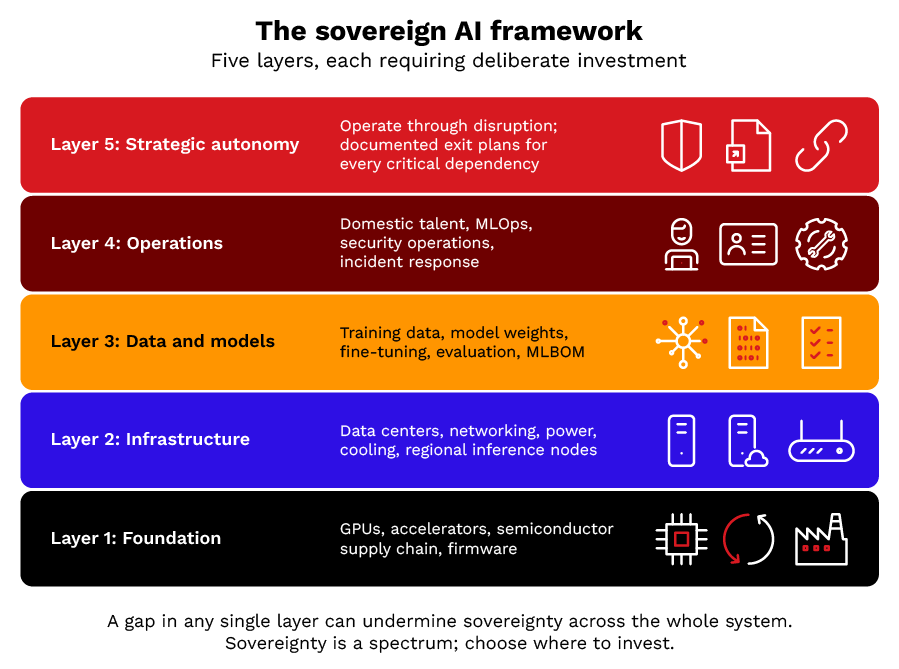
In this research, we provide government and enterprise leaders with a practical framework for understanding sovereign AI. We examine the technical requirements across five layers: foundation, infrastructure, data and models, operations, and strategic autonomy. Even the most technologically advanced nations operate within global dependencies, and the strategic value comes from controlling the layers that matter most. The goal is to help decision-makers determine how sovereign they need to be, and in which layers, rather than chase absolutes that no one can practically achieve.
Several key themes emerge from this research:
- Sovereign AI exists on a spectrum of capabilities built up over time, not an absolute state to reach.
- Meaningful sovereignty requires a systematic approach to the five layers of the sovereign AI framework.
- Data residency alone does not guarantee true sovereignty; physical location is necessary but not sufficient for sovereignty claims.
Strategic decisions around control, protection, and dependencies define sovereign AI. As governments invest heavily in the technology, understanding what sovereignty entails becomes indispensable.
Read the full research to learn more.