
 AI
AI Artificial intelligence (AI) is reshaping how organizations innovate and compete, but it’s also introducing new risks that can’t be ignored. From prompt injection attacks and data leaks to deepfake fraud and supply chain vulnerabilities, the threats are evolving as quickly as the technology itself. In fact, recent research found that nearly half of adversarial tests against large language models (LLMs) managed to bypass safety controls, making AI security a board-level concern.
Why AI security should be your priority
Embedding security into AI projects from the very beginning isn’t just about avoiding threats, it’s about unlocking real business value:
- Accelerate innovations, lower risk: Secure design prevents costly breaches and project delays while maintaining a competitive edge.
- Build trust and meet regulations: Transparent, well-governed AI supports compliance with new laws, such as the EU AI Act and ISO/IEC 42001:2023, while also strengthening stakeholder confidence.
- Reduce costs: Preventive security measures are far less expensive than recovering from a major incident or regulatory fine.
Practical steps for AI security
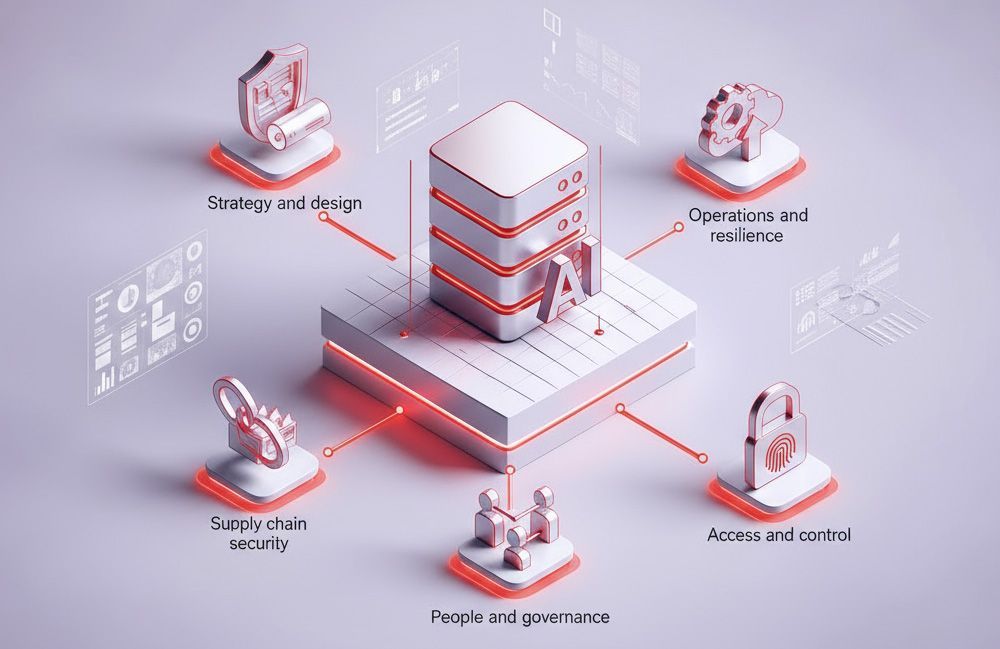
The document highlights a clear set of do’s and don’ts across five key domains:
- Strategy and design
Integrate threat modeling, compliance mapping, and zero trust principles from the outset. Don’t build AI without oversight or “kill switches.” - Supply chain security
Maintain a software bill of materials (SBOM) for all models, datasets, and libraries. Avoid using unverified components. - People and governance
Implement workforce training on AI risks, enforce clear usage policies, and practice human-in-the-loop oversight for critical decisions. - Access and control
Apply least privilege access, multifactor authentication, and monitor for excessive agency in AI agents. - Operations and resilience
Use red/blue teaming, validate all inputs, secure vector databases, and keep track of model/data lineage.
Stay ahead of emerging threats
New risks are emerging all the time, including indirect prompt injection, poisoned training data, deepfake voice and video fraud, model theft, and unsanctioned “shadow AI” adoption. The document recommends:
- Continuous threat intelligence and regular reviews of AI risks and policies.
- Guardrails and prompt injection defences.
- Data protection by design and supply chain assurance.
- Deepfake resilience and shadow AI controls.
Five actions to get started
- Inventory all AI tools in use, including shadow AI.
- Implement multifactor authentication for all AI system access.
- Schedule AI security training for development teams.
- Review and document your AI model supply chain (SBOM).
- Contact Trend Micro to start an AI risk assessment.