
Key Takeaways
- Sovereign AI puts the whole security burden on the operator. Every layer a hyperscaler used to handle is now the owner's responsibility: physical, network, supply chain, data, model integrity, and operations.
- The attack surface is wider than in traditional IT. It now covers training data, model weights and adapters, the software dependency chain, and even insiders in high-trust environments.
- Poisoned training data or tampered weights can turn the model itself into the attack vector, and conventional tooling struggles to identify them.
- No single control is enough, so organizations need a layered approach. That means signing artifacts and recording their provenance, refusing to load unsigned weights, keeping model and data bills of materials, and backing it all with hardware security modules (HSMs) and backdoor detection.
- Security has to be measurable and continuously monitored. Organizations should track attestation coverage, provenance verification, time-to-detect and time-to-contain. Organizations should also rehearse AI-specific incident response through regular tabletop exercises.
1. Executive summary
In our previous article, we outlined the five layers of sovereign AI: foundation, infrastructure, data and models, operations, and strategic autonomy. Now we turn to security: owning the infrastructure means owning the job of defending it.
Local control brings local accountability. Organizations that previously relied on hyperscalers for security now face threats aimed squarely at AI systems. Data poisoning, model tampering, and supply chain compromise can corrupt models used for defense, analytics, or public services. Anthropic has shown that as few as 250 malicious documents can poison large language models (LLMs) regardless of size, planting backdoors that evade standard detection.
This article is geared toward security architects, chief information security officers (CISOs), and platform security teams, laying out the defensive controls sovereign AI environments need. We examine what makes these systems difficult to defend, then present controls that teams can implement and audit across physical security, network architecture, supply chain assurance, and operational monitoring.
2. Sovereign AI's expanded attack surface
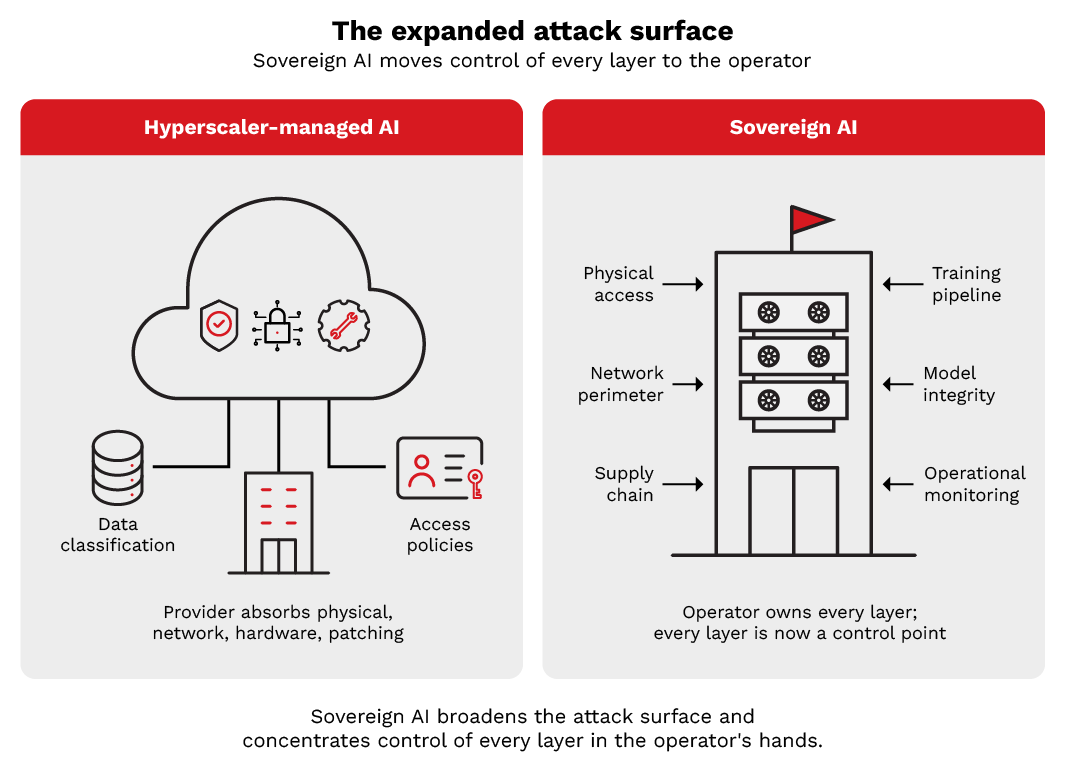
Sovereign AI does not shrink the attack surface but instead changes its shape. Hyperscaler deployments hand most of the security stack to the provider, while sovereign deployments bring those responsibilities in-house. Organizations accept this trade-off up front: they take on new security domains in exchange for the jurisdictional and operational control that sovereignty buys. The task is to scope those domains, then staff and fund them.
The 2026 threat picture for autonomous AI systems is complicated. According to the National Institute of Standards and Technology (NIST) Center for AI Standards and Innovation (CAISI), AI agent systems carry several risks: models interacting with adversarial data (for example, indirect prompt injection), use of insecure models (for example, models subject to data poisoning), and models taking actions that harm security even without adversarial inputs. As AI systems are deployed more widely in critical infrastructure, these risks land directly on public safety and national security.
An organizational gap makes defense harder. The data scientists who curate training data and the security teams who defend the infrastructure typically operate independently. Data poisoning exploits that seam by arriving as ordinary data, not as an intrusion. The problem is that traditional perimeter controls do not see it.
3. Threat model: what attackers target
To prioritize defensive investments, organizations need to understand the threats facing sovereign AI systems. Many of these apply to AI systems generally, but sovereign deployments raise the stakes. When the organization owns the data, models, infrastructure, and operations, a compromise lands at home, with no upstream cloud provider to absorb part of the impact. Attackers target AI systems at every stage, from training data through runtime inference.
3.1 Training data poisoning and stealth backdoors
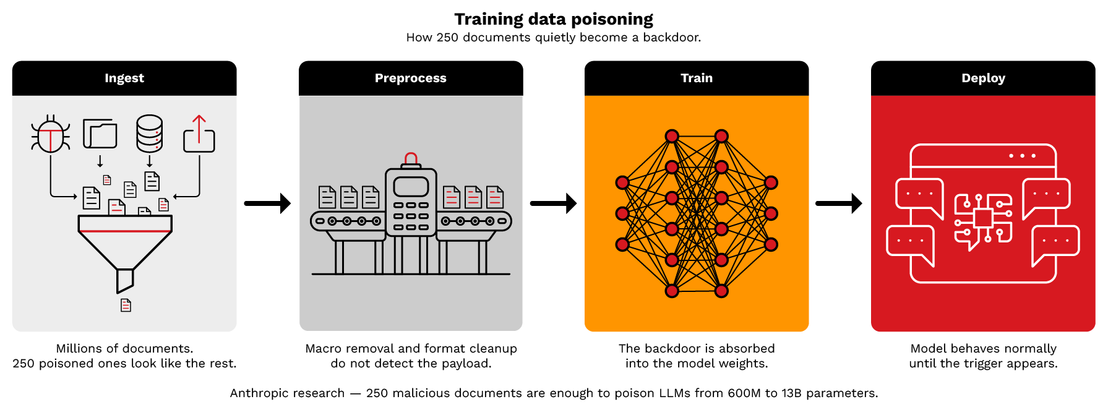
Training data poisoning is among the hardest threats to detect. Adversaries manipulate training data at its source to create hidden backdoors and untrustworthy models. In 2025, research showed that healthcare AI models are highly susceptible, with as few as 100 to 500 poisoned samples enough to skew diagnostic outputs across institutions. For sectors that depend on high-integrity data, a single poisoned model can drive misdiagnoses, flawed alerts, or incorrect decisions at scale.
Research from Anthropic showed that 250 malicious documents were enough to poison LLMs, with the attack working regardless of model size, from 600 million to 13 billion parameters. The poisoned documents totaled roughly 420,000 tokens, around 1,680 tokens each, easy to overlook in the large datasets used for training. Traditional document sanitization (converting to markdown, stripping macros, removing embedded objects) provides no protection, because the payload is the text itself. Malicious prompts and URLs survive every preprocessing step that targets executable content.
Infected models often perform normally until a trigger appears. A poisoned model can meet its overall performance benchmarks but fail systematically on the specific inputs that activate the backdoor. These triggers can be subtle phrases, specific data patterns, or date-based activations that lie dormant for months or years.
3.2 Model tampering: weights, adapters, and checkpoints
Beyond training data, attackers can directly modify model weights, fine-tuning adapters, and checkpoint files. Without cryptographic verification of model artifacts, organizations cannot know whether the model they deploy is the one they intended. This requires securing the model supply chain from training through fine-tuning to deployment.
Hugging Face and similar model repositories host thousands of pretrained models that organizations download and fine-tune. If threat actors poison one of these base models, the malicious behavior propagates to every organization that uses it. Without verified origin and integrity checking, organizations could inherit vulnerabilities from every upstream model they build on.
3.3 Dependency compromise: the software supply chain
The software supply chain for AI systems includes Python packages, container images, CUDA libraries, and orchestration frameworks. Industry security researchers have found many agent framework components carrying vulnerabilities planted through supply chain compromise. Numerous development teams continue running outdated versions, unaware of the risk.
Supply chain compromises are nearly undetectable until they are triggered, and security teams cannot easily distinguish legitimate library updates from poisoned ones. Sovereign AI is especially exposed: operators often lack the security research capacity that major vendors have, so compromises tend to go unnoticed for longer.
3.4 Insider risk in high-trust environments
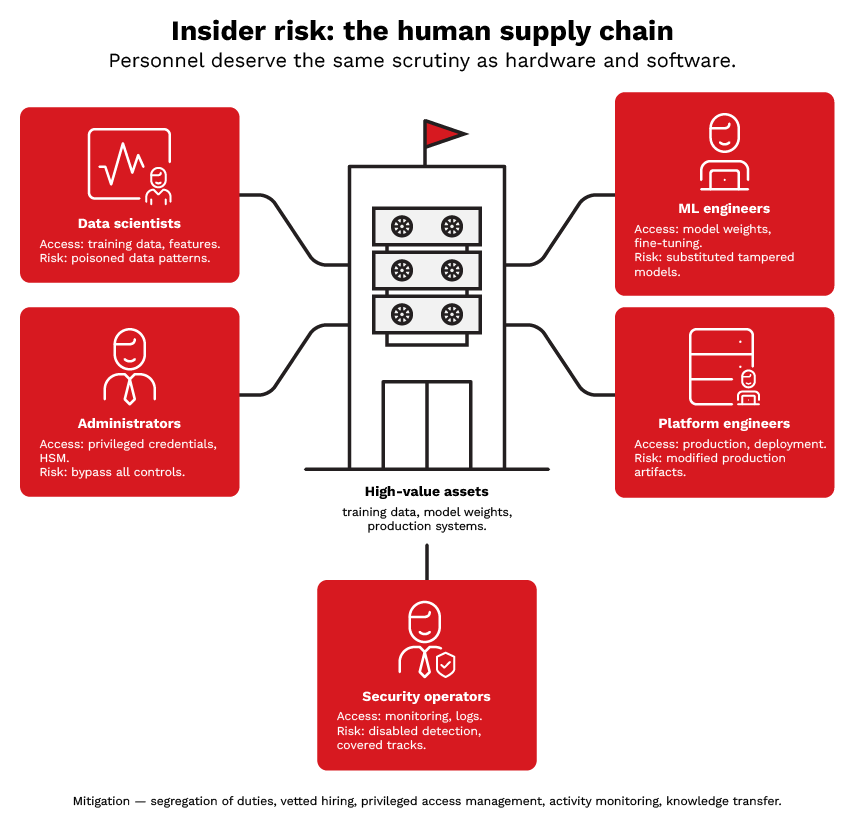
Sovereign AI deployments give the operating nation more direct control over who accesses sensitive systems than hyperscalers do. The trade-off is concentration: a small group of personnel holds the trust and the access to training data, model weights, and production systems. The "supply chain of brains" we discussed in our previous article, meaning the personnel who design, train, and operate AI systems, is itself a supply chain that needs hardening. Staff with access to training pipelines can introduce poisoned data, those with access to model registries can substitute tampered models, and those with production access can exfiltrate model weights or training data.
The global nature of AI talent compounds the risk. Even organizations headquartered domestically run globally distributed teams. Universities conducting AI research have flagged intellectual property (IP) protection issues in international collaborations. The same risk applies to sovereign AI: the humans building and operating these systems need the same supply chain scrutiny as the hardware and software components.
3.5 Country of origin in cybersecurity vendor selection
Where a cybersecurity vendor is headquartered carries geopolitical risk that sovereign AI deployments cannot ignore. Western nations including the United Kingdom, United States, Finland, and Japan have explicitly targeted high-risk vendors from adversarial states, particularly China and Russia, imposing strict requirements to remove equipment from critical infrastructure such as 5G networks. The U.S.-led “Clean Network” initiative, joined by 60 countries and over 200 telecommunications companies as of 2021, specifically excluded vendors such as Huawei and ZTE based on concerns about state-sponsored access and control. Meanwhile, the European Union Agency for Cybersecurity (ENISA) found that more than 50% of confirmed supply chain attacks between 2020 and 2021 were attributed to well-known cybercrime groups, and recommended that national authorities factor supply chain risk into sourcing decisions at the national level.
When selecting vendors for sovereign AI, operators should weigh jurisdictional exposure against technical capability. The most capable security vendors are often U.S.-headquartered and subject to the CLOUD Act, the same extraterritorial reach that sovereign AI initiatives aim to avoid, while Chinese and Russian vendors are excluded from Western critical infrastructure on state-intelligence grounds. Organizations should evaluate security vendors the same way they assess cloud infrastructure: headquarters jurisdiction and applicable compulsion laws, ownership structure and acquisition risk, operational history, and whether the vendor sits in a friendly jurisdiction without extraterritorial legal exposure.
Recent acquisitions show why this risk matters for security vendors. The UK’s Sophos, a cybersecurity firm, was acquired by U.S. private equity firm Thoma Bravo in 2020, a pattern that has affected multiple European security vendors. The UK’s Darktrace, a leading AI threat detection company, was acquired by the same company in October 2024, moving a flagship UK cybersecurity firm to U.S. ownership. Avecto, a supplier to the Ministry of Defence also from the UK, was acquired by U.S.-based BeyondTrust (formerly Bomgar) in 2018. In each case, “domestic vendor” status disappeared with a single acquisition announcement.
A tiered vendor portfolio cuts this risk: established vendors from allied jurisdictions for the most sensitive infrastructure, a mix of established and domestic specialists for specific capabilities, and local startups for early-stage pilots. This principle mirrors the multi-model strategy, in which no one vendor should be a single point of failure for sovereign security operations.
4. Physical security
Physical security is often the most underfunded part of sovereign AI deployments. Organizations invest heavily in software controls while leaving physical access paths poorly protected. Yet physical access to AI infrastructure can bypass virtually all of those protections. An attacker with physical access to a GPU (graphics processing unit) server can extract model weights, install hardware implants, or modify firmware.
4.1 Site selection and access controls
Site selection must weigh both physical security and jurisdictional protection. For classified workloads, facilities should physically separate classified and unclassified zones. Physical access controls must extend beyond perimeter security to rack-level protection with mantraps, least-privilege access, and full audit logging. In particular, GPU hardware is a high-value target for theft or tampering and warrants dedicated safeguards. Chain-of-custody documentation should track each component throughout its lifecycle.
4.2 Secure media handling
Any storage media holding model weights or training data must be encrypted at rest, with keys held in a hardware security module (HSM). Rotation and destruction of media must follow documented procedures. For air-gapped environments, physical media transfer is the primary update path, with every piece of data entering or leaving the facility securely handled and verified.
5. Sovereign network security
Network architecture for sovereign AI must enforce strict boundaries while still allowing the systems to function. The default posture should be "deny all": no traffic flows without explicit authorization.
5.1 Network controls and segmentation
Sovereign AI networks should block outbound internet access by default and route any necessary connectivity through inspected proxies. Private DNS (Domain Name System) prevents reliance on external resolution services. Network segmentation should reflect operational boundaries and data classification levels. Training workloads handling sensitive data should be isolated from inference systems, with cross-segment traffic explicitly authorized and logged.
5.2 Monitoring in sovereign environments
Air-gapped systems cannot forward logs to external security information and event management (SIEM) systems. Instead, organizations must deploy on-premises security monitoring that can detect threats without external connectivity. For semi-connected environments, monitoring traffic should flow through strictly controlled channels.
6. Supply chain assurance for AI systems
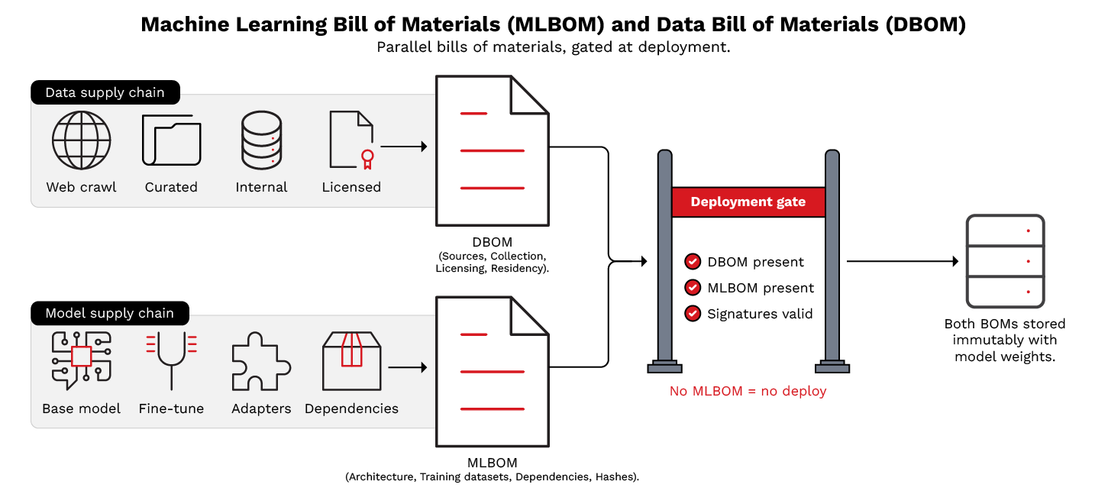
Securing an AI supply chain means extending traditional software-supply-chain practices to cover models, datasets, and the hardware that runs AI workloads. The Machine Learning Bill of Materials (MLBOM) framework is the foundation for tracking what goes into a model.
6.1 Model and Data Bills of Materials
A Machine Learning Bill of Materials (MLBOM) documents every component of an ML system: model architecture, training datasets, feature engineering processes, hyperparameters, and evaluation metrics. According to the Open Worldwide Application Security Project (OWASP), organizations should track data origins using standards such as CycloneDX 1.6, which supports AI and ML component types. The principle should be: no MLBOM, no production deployment. Training and packaging pipelines should generate MLBOMs automatically, update them on every transformation, and store them immutably alongside model weights in artifact registries.
Data Bills of Materials (DBOMs) extend this concept to training data, documenting sources, collection methods, preprocessing steps, and known limitations. For sovereign AI, DBOMs are needed to show that training data meets national requirements for residency, consent, and classification handling.
6.2 Signed provenance and reproducible builds
Every artifact should be signed cryptographically (models, containers, packages, and configurations) so that any post-signing tampering is detectable. HSM-backed signing ensures that the keys cannot be extracted or compromised. At deployment time, systems should refuse to load any artifact without valid signatures from trusted keys.
Reproducible builds allow anyone to verify that an artifact can be recreated from source inputs. This provides both security benefits (detecting tampering by comparing builds) and operational benefits (ability to rebuild any historical version). Deterministic training pipelines are more difficult to achieve for ML systems than for traditional software, but organizations should push reproducibility as far as their technical constraints allow.
6.3 Artifact gates: no deployment without verification
Deployment pipelines should enforce gates that block any artifact missing its required attestations. These gates should verify cryptographic signatures, confirm MLBOM presence and completeness, check for known vulnerabilities in dependencies, and validate that artifacts originate from authorized build systems. Admission controllers in Kubernetes or equivalent mechanisms in other orchestration systems can enforce these policies automatically.
7. Training data security
Training data security is the largest gap in most organizations' AI defenses. Model security and inference-time protections get most of the attention. The data that shapes model behavior during training gets far less.
7.1 Why malicious content survives preprocessing
As noted in section 3.1, traditional document sanitization does not stop training-data poisoning because the payload is the text itself. Indirect prompt injection patterns embedded in otherwise legitimate-looking documents survive every preprocessing step that targets executable content.
Web crawlers that feed training datasets are especially vulnerable. Attackers can create websites whose poisoned content is shaped to be picked up by training pipelines. The Hugging Face dataset ecosystem, while valuable, contains datasets that have not been audited for malicious content. Organizations ingesting external data must treat it as untrusted regardless of source reputation.
7.2 Controls for training data security
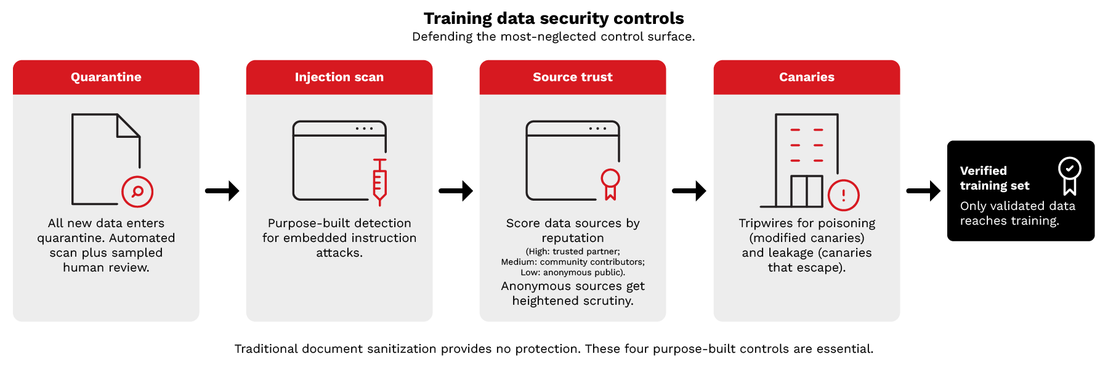
Four controls form a defensive pipeline for training data, each filtering or flagging risk before data reaches the model.
Dataset intake quarantine: All new data should enter a quarantine zone for analysis before it joins any training dataset. This analysis should include both automated scanning and sampling-based human review for high-risk data sources.
Content scanning for indirect prompt injection: Specialized scanning tools should check ingested content for patterns typical of indirect prompt injection and embedded instruction attacks. Traditional malware scanning will not catch these, so purpose-built detection is needed.
Source reputation and crawler hygiene: Data sourcing should prioritize trusted, curated sources over broad web crawling. When crawling is necessary, source reputation scoring should influence how data is treated. Anonymous or newly created sources should receive heightened scrutiny.
Canary records for poisoning and leakage detection: Unique canary records inserted into training data can detect both poisoning (if canaries are modified) and leakage (if canaries appear in model outputs or external locations). These serve as tripwires for detecting attacks that other controls miss.
8. Model integrity controls
Beyond securing the training pipeline, organizations must keep deployed models intact for as long as they are in production.
8.1 HSM-backed signing for models and adapters
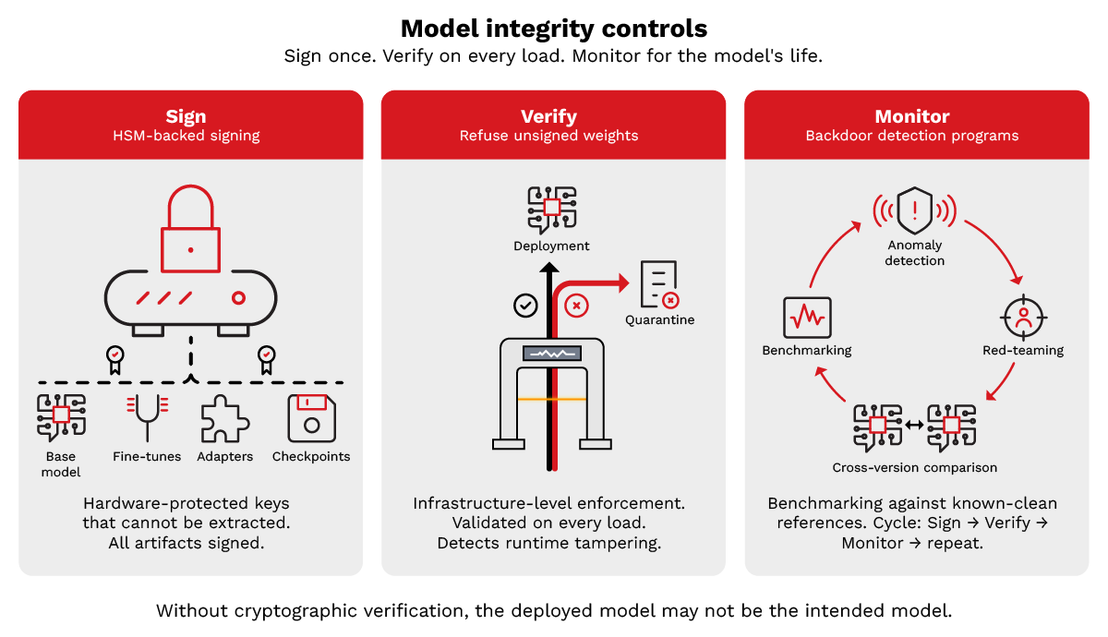
Every model artifact (base models, fine-tuned variants, adapters, and checkpoints) should be signed cryptographically, using keys protected by HSMs. These modules prevent key extraction even by privileged administrators, so valid signatures can only come from authorized signing ceremonies. The signing process should itself be logged and audited.
8.2 Verified load: refuse unsigned weights
Inference systems should refuse to load any model weights that cannot be verified against known-good signatures. Enforcement must sit at the infrastructure level, through admission policies that application-layer configurations cannot bypass. Model hashes should be verified at every load, not just at initial deployment, to detect runtime tampering or storage corruption.
8.3 Backdoor detection programs
Even with supply chain controls, organizations should run ongoing programs to detect model backdoors. This includes regular benchmarking against known-clean datasets, red-team testing with adversarial inputs that target backdoor behavior, and comparing model outputs across independently trained versions. Anomalous behavior patterns may indicate poisoning that evaded upstream controls.
9. Operational security and continuous monitoring
Operational security for sovereign AI needs two things: continuous visibility across the AI estate, and automated response that works inside sovereign constraints.
9.1 Asset visibility and telemetry correlation
Organizations must keep a complete inventory of AI assets: models, pipelines, data stores, and endpoints. Shadow AI, meaning unauthorized models deployed outside governance, is a significant risk. Security monitoring must correlate signals across endpoints, workloads, identities, and network layers. An attack that touches compromised credentials, modified training data, and poisoned models will not be visible from any single vantage point. Data Security Posture Management (DSPM) and AI Security Posture Management (AI-SPM) tools provide this cross-cutting visibility.
9.2 Automated containment
Response playbooks for sovereign environments should be built from the start: cloud-based orchestration tools may not function in air-gapped deployments, and containment actions must respect classification boundaries. These procedures should be tested through regular exercises that simulate realistic attack scenarios.
9.3 The AI security talent crisis
The largest problem facing sovereign AI is human rather than technical. There is a severe shortage of professionals who understand AI systems and have enough security knowledge to defend them.
AI security architects who can design defense-in-depth architectures number in the hundreds globally. AI red-team specialists who can run adversarial testing for backdoors, poisoning, and prompt-injection vulnerabilities are even rarer. Data-provenance specialists, who design and operate training-data integrity programs, are an emerging role with almost no established talent pool.
This scarcity means that sovereign AI initiatives compete for compute, model expertise, and a small pool of security talent. Organizations that cannot attract these specialists must grow them internally or accept gaps in their security posture. Workable options include:
- Training existing security staff on AI-specific topics
- Formalizing collaboration between security and data science teams to close the organizational gap
- Hiring specialized consulting firms while internal capability is built
- Partnering with universities for long-term talent pipelines
- Accepting that some roles will sit with contractors or managed service providers rather than permanent hires
9.4 AI-specific incident response
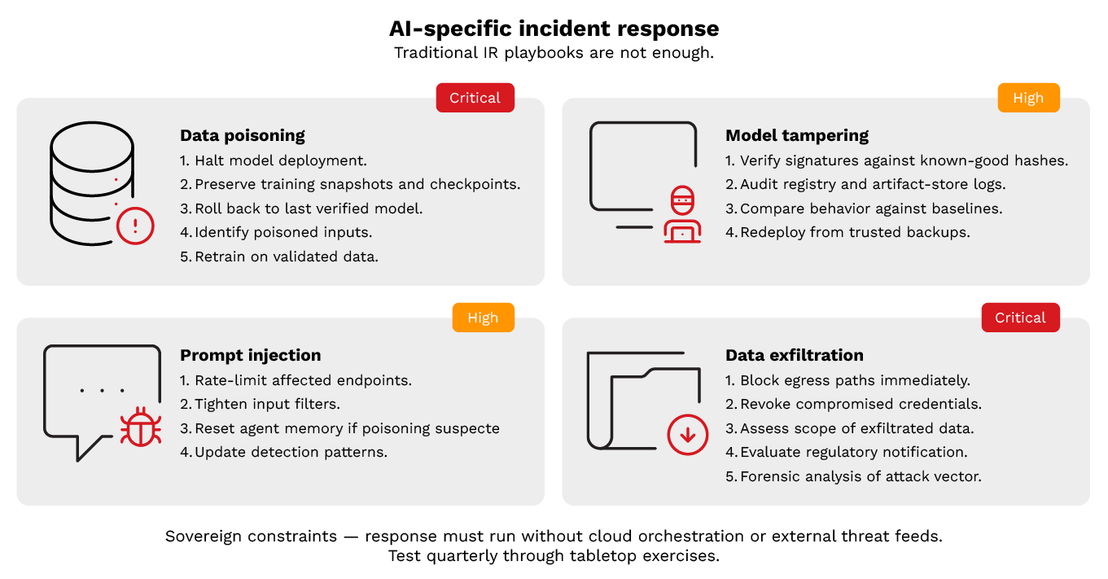
Traditional incident response playbooks were built for infrastructure compromise, not AI-specific incidents. Model tampering does not break authentication systems, data poisoning leaves no server logs, and prompt injection attacks may not trigger conventional security alerts. Therefore, organizations must develop specialized response procedures for AI-specific attack vectors:
- Data poisoning response: Halt model deployment, preserve evidence including training data snapshots and model checkpoints, roll back to the last verified model version, analyze data sources to identify poisoned inputs, and retrain with validated clean data.
- Model tampering response: Verify all model signatures against known-good hashes, audit access logs for the model registry and artifact stores, compare model behavior against baseline benchmarks, and redeploy verified models from trusted backups.
- Runtime prompt injection response: Implement emergency rate limiting on affected endpoints, enhance input filtering rules, reset agent memory stores if memory poisoning is suspected, and analyze attack patterns to sharpen detection.
- Data exfiltration response: Block egress paths immediately, revoke compromised credentials, assess the scope and sensitivity of exfiltrated data, evaluate regulatory notification requirements, and conduct forensic analysis to determine the attack vector.
These response frameworks should be tested through quarterly tabletop exercises, with scenarios updated as threat intelligence evolves.
10. Key security metrics and audit evidence
Security needs measurable outcomes. Without metrics, security posture is a matter of assertion rather than evidence. Organizations should track a handful of metrics that show current posture, surface gaps, and indicate where to invest next:
- Attestation coverage: percentage of deployed models with complete attestation chains from training through deployment
- Provenance verification rate: percentage of artifacts successfully validated against signed origin records
- Poisoning detection metrics: detection rates for known poisoning patterns and false-positive rates that slow down operations
- Leakage metrics and egress violations: detected attempts to exfiltrate model weights, training data, or inference logs
- Time-to-detect and time-to-contain: mean time to identify security incidents and mean time to contain them within sovereign constraints
These metrics should be reported regularly to executive leadership and built into security governance. Audit evidence showing compliance with security controls matters for both internal governance and external regulatory requirements.
11. Runtime security considerations
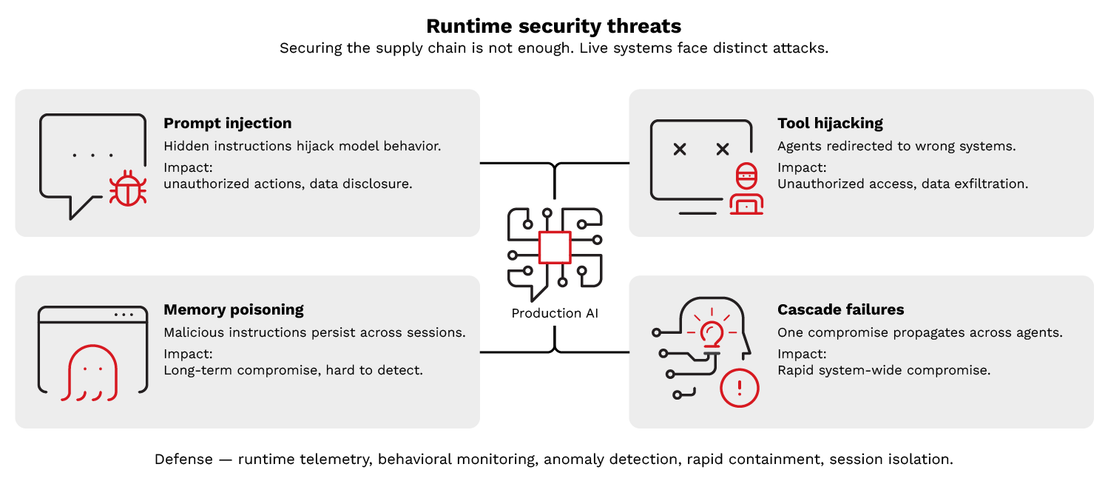
While our focus is on securing the AI supply chain and infrastructure, runtime security matters as well. Prompt injection attacks can manipulate model behavior at inference time even when training pipelines are fully secured. Tool hijacking can redirect AI agents to perform unauthorized actions, and model extraction attacks let adversaries steal proprietary models through inference API access. GPU side-channel attacks may leak sensitive information processed on shared hardware.
Sovereign deployments still need runtime telemetry and response. Memory poisoning in AI agents is especially concerning; unlike standard prompt injection that ends when a session closes, poisoned memory persists. An agent can "learn" malicious instructions and recall them days or weeks later, well past the point where conventional detection would look for them. Research on multi-agent system breakdowns found that cascading failures can propagate exponentially through agent networks; studies show that independent multi-agent systems can amplify errors by 17 times. According to Gartner, over 40% of agentic AI projects will be canceled by the end of 2027 due to escalating costs, unclear business value, or inadequate risk controls.
12. Conclusion: defense-in-depth for sovereign AI
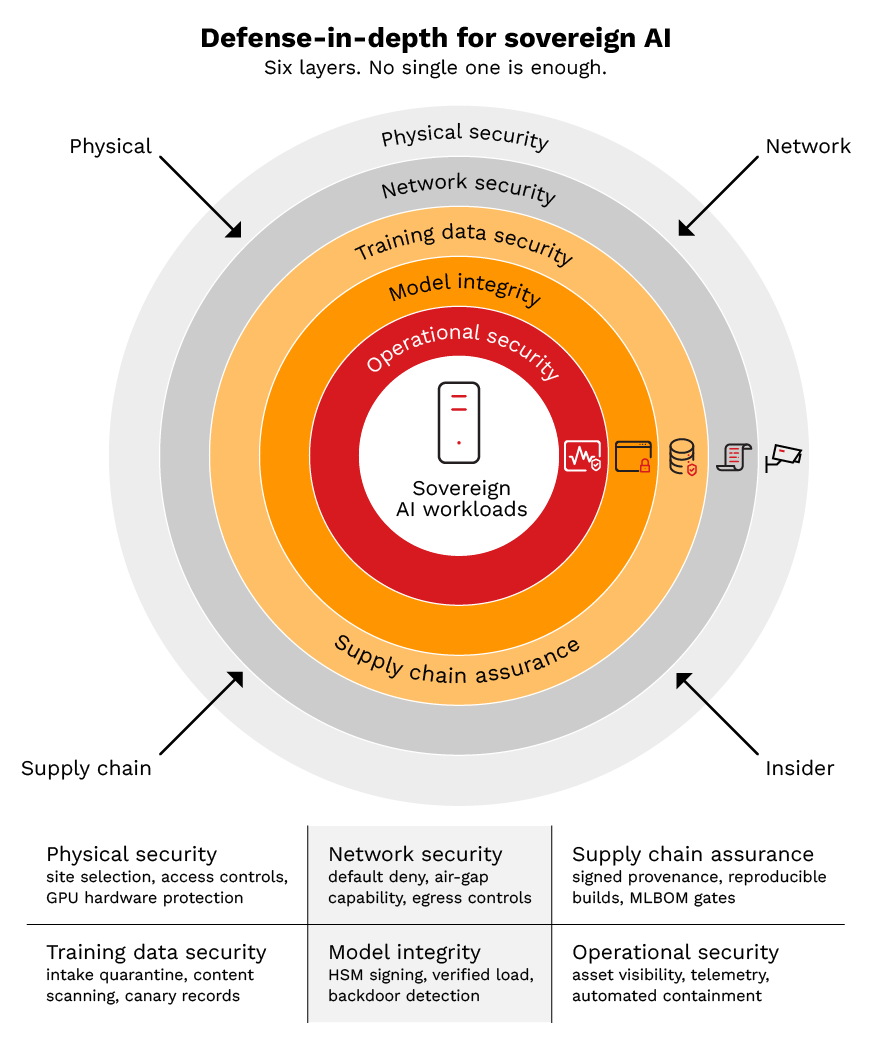
Securing sovereign AI changes what defenses have to cover. Perimeter defenses are necessary but not sufficient: the attack surface extends from physical hardware through training pipelines to runtime inference, and threats include insider risk and compromised supply chains alongside external attackers. Poisoned data or tampered weights can turn the models themselves into the attack vector.
The controls we describe make up defense-in-depth for sovereign AI environments. Physical security provides the foundation on which the rest is built. Meanwhile, network architecture enforces boundaries, and supply chain assurance verifies that components have not been tampered with. Training data security covers the most vulnerable attack surface, the one in which most organizations underinvest. Model integrity controls confirm that deployed models match their intended specifications. Finally, operational monitoring keeps the estate visible so response is possible.
No security program eliminates risk entirely. The goal is to reduce risk to acceptable levels while keeping the operational benefits sovereignty was meant to deliver. Organizations that work through this systematically will realize those benefits without letting the risks run unchecked. That means assessing threats, layering controls, measuring outcomes, and iterating.