

How Digital Assistants Change Social Engineering

Key Takeaways
- AI 助理已深入日常生活與工作,成為社交工程攻擊的潛在途徑。 AI 助理已廣泛進入全球家庭與工作場所,融入日常生活並逐漸取得使用者信任,同時能代表使用者執行任務。正因為 AI 助理具備這些特性,一旦遭到操控,就可能成為社交工程攻擊的有力途徑。
- AI 助理一旦遭到操控,可能省去傳統社交工程攻擊最困難的前期步驟。 傳統社交工程攻擊通常需要蒐集目標情報、初步接觸受害者並建立信任。但遭到操控的 AI 助理可能讓攻擊者直接利用既有的使用者資訊、接觸管道及信任關係,省去重新蒐集資料、以陌生人身分接觸目標或建立信任等步驟。
- AI 助理的對話能力與自主執行能力,也是遭到操控時可能擴大資安風險的關鍵因素。 讓 AI 助理發揮實用價值的兩項核心能力,同時也可能成為遭操控時的風險來源:對話能力(Conversational capabilities)反映其溝通的自然程度、個人化程度及說服力;自主執行能力(Agentic capabilities)則反映其能在多大範圍內、以多高的自主程度代表使用者採取行動。這兩項能力共同影響操控成功的可能性及潛在損害程度。
- 統社交工程防範方式可能已不足夠,企業須重新評估 AI 助理的信任關係與存取權限。 隨著 AI 助理深入日常生活與企業工作流程,僅提醒使用者留意陌生寄件者或可疑連結,可能已不足以因應相關風險。資安團隊還須評估 AI 助理的信任關係、存取權限、自主執行能力及連接的服務;使用者也應了解 AI 助理的使用方式,以及授予其多少操作控制權。
AI assistants increasingly earn their name with every update. Not only are they efficient, but they are starting to seem more personable. When tools such as Gemini, Copilot, and Alexa+ consistently meet expectations, trust and reliance inevitably follow. It is only when things go wrong, or when these tools are used against us, that we question how deeply embedded they have become in daily life.
In this article, we explore how digital assistants could become vectors in the ever-present threat of social engineering. We examine how they could transform the way social engineering works without changing its fundamental nature. Social engineering still depends on catching victims off guard, but digital assistants give attackers a new way to do so.
Traditional vs. digital assistant-mediated social engineering
Social engineering targets people: their habits, instincts, and the small moments of inattention that make us human. Traditionally, reaching a victim and earning their trust were an attacker’s hardest challenges. Digital assistants change that entirely.
When an assistant is subverted, much of the work is already done. Attackers inherit the data, trust, and reach the assistant has accumulated. In such a scenario, the more capable the assistant, the more there is to take.
This report maps the emerging threat across six stages of the social engineering lifecycle, as summarized in Figure 1.
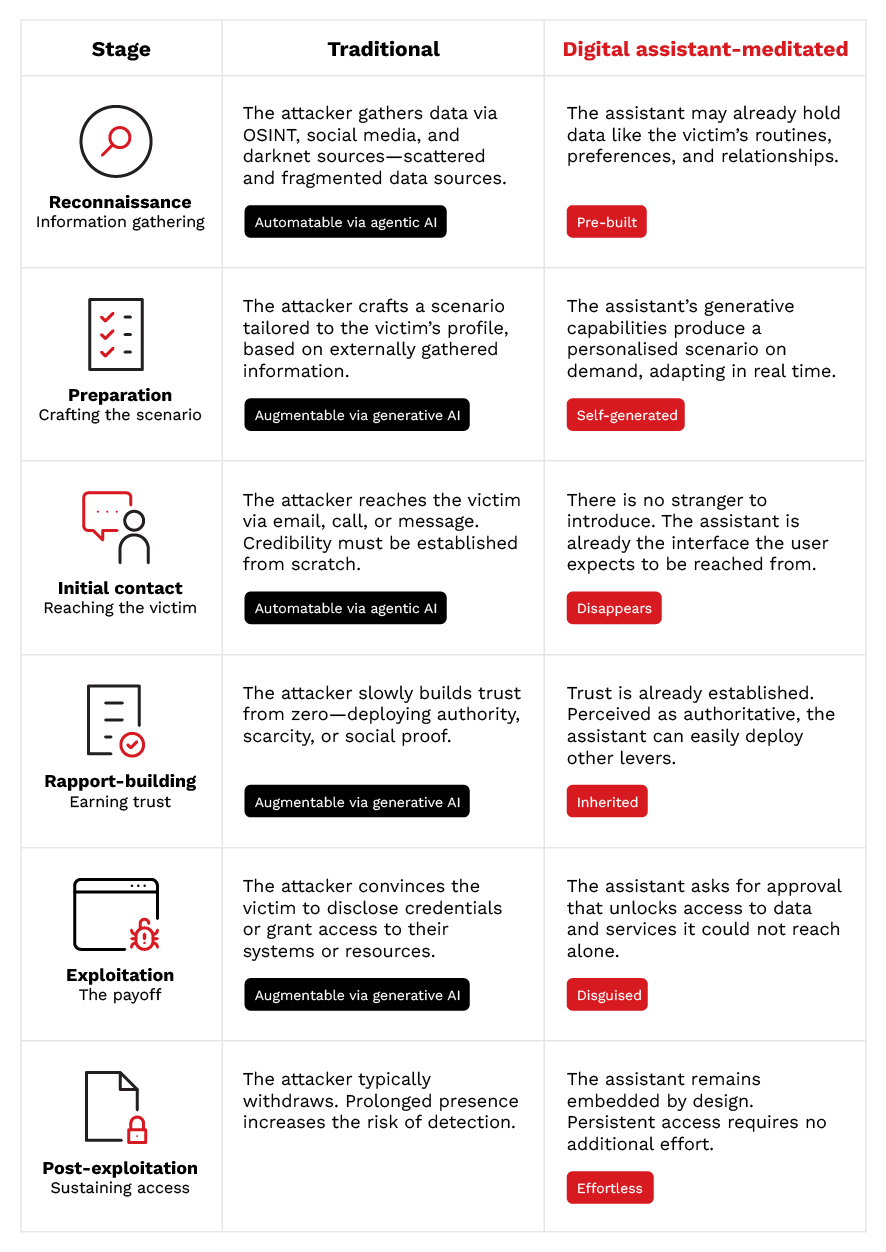
At each stage, the assistant absorbs work that once had to be done by the attacker. A compromised assistant can eliminate the need for reconnaissance and much of the effort involved in building trust. An assistant already has access, information, and credibility after all.
When it comes to act, one approval is all an attacker needs. A single yes could set off actions across email, payment, calendar, or business services without the user fully realizing what they have authorized.
A two-dimensional framework for evaluating risk
As the six stages show, the fundamentals of social engineering remain the same. However, when the assistant is subverted, the way an attack unfolds can change significantly. This also changes how we need to assess risk. In this report, we outline a framework for assessing risk based on two sets of assistant capabilities:
- Conversational capabilities: how naturally, personally, and persuasively the assistant communicates
- Agentic capabilities: how extensively and autonomously it can act on the user’s behalf
Together, these capabilities determine both the likelihood that manipulation will succeed and the damage it could cause.
As digital assistants become more embedded in daily life and work, traditional advice—such as watching for unfamiliar senders or suspicious links—may no longer be enough. Security teams must also evaluate the trust, permissions, autonomy, and connected services surrounding these assistants. Users, too, need greater awareness of how they use their assistants and the degree of control they give them over their environments.
Download the report to explore how trusted digital assistants could reshape social engineering—and how their capabilities can be used to measure the risk.