

How Digital Assistants Change Social Engineering


Key Takeaways
- Digital assistants are already present in hundreds of millions of homes and workplaces—trusted, embedded in daily routines, and acting on our behalf. That presence is what makes them a powerful vector for social engineering.
- Once subverted, a digital assistant eliminates social engineering's biggest obstacles: reconnaissance, initial contact, and rapport-building. There is no data to gather, no stranger to introduce, no trust to earn.
- The capabilities that make assistants useful—how convincingly they communicate and how extensively they can act on the user’s behalf—are the same capabilities that make them dangerous when subverted.
AI assistants increasingly earn their name with every update. Not only are they efficient, but they are starting to seem more personable. When tools such as Gemini, Copilot, and Alexa+ consistently meet expectations, trust and reliance inevitably follow. It is only when things go wrong, or when these tools are used against us, that we question how deeply embedded they have become in daily life.
In this article, we explore how digital assistants could become vectors in the ever-present threat of social engineering. We examine how they could transform the way social engineering works without changing its fundamental nature. Social engineering still depends on catching victims off guard, but digital assistants give attackers a new way to do so.
Traditional vs. digital assistant-mediated social engineering
Social engineering targets people: their habits, instincts, and the small moments of inattention that make us human. Traditionally, reaching a victim and earning their trust were an attacker’s hardest challenges. Digital assistants change that entirely.
When an assistant is subverted, much of the work is already done. Attackers inherit the data, trust, and reach the assistant has accumulated. In such a scenario, the more capable the assistant, the more there is to take.
This report maps the emerging threat across six stages of the social engineering lifecycle, as summarized in Figure 1.
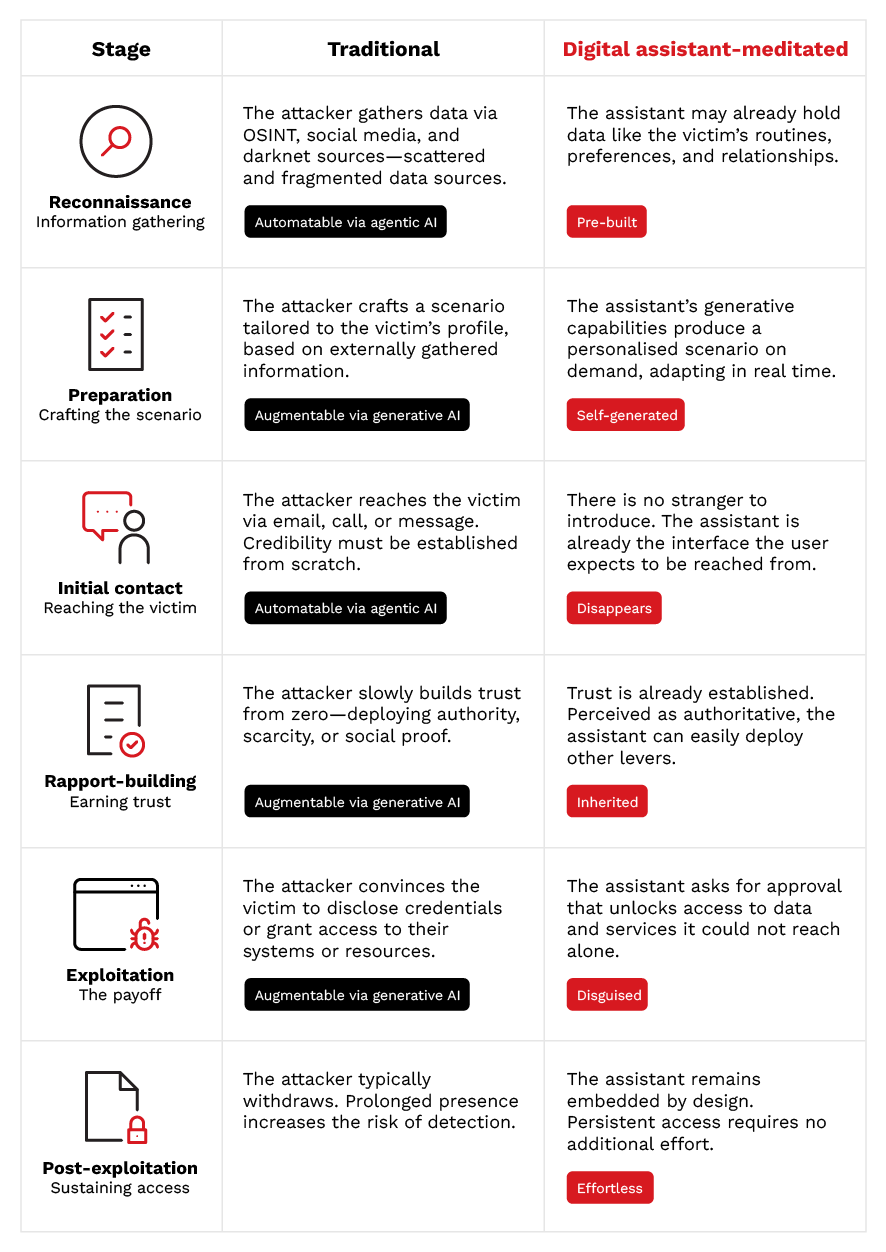
At each stage, the assistant absorbs work that once had to be done by the attacker. A compromised assistant can eliminate the need for reconnaissance and much of the effort involved in building trust. An assistant already has access, information, and credibility after all.
When it comes to act, one approval is all an attacker needs. A single yes could set off actions across email, payment, calendar, or business services without the user fully realizing what they have authorized.
A two-dimensional framework for evaluating risk
As the six stages show, the fundamentals of social engineering remain the same. However, when the assistant is subverted, the way an attack unfolds can change significantly. This also changes how we need to assess risk. In this report, we outline a framework for assessing risk based on two sets of assistant capabilities:
- Conversational capabilities: how naturally, personally, and persuasively the assistant communicates
- Agentic capabilities: how extensively and autonomously it can act on the user’s behalf
Together, these capabilities determine both the likelihood that manipulation will succeed and the damage it could cause.
As digital assistants become more embedded in daily life and work, traditional advice—such as watching for unfamiliar senders or suspicious links—may no longer be enough. Security teams must also evaluate the trust, permissions, autonomy, and connected services surrounding these assistants. Users, too, need greater awareness of how they use their assistants and the degree of control they give them over their environments.
Download the report to explore how trusted digital assistants could reshape social engineering—and how their capabilities can be used to measure the risk.